 munKNEE.com Your Key to Making Money
Hyperinflation is perhaps the darkest side of a government fiat money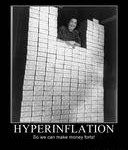 regime. Among mainstream economists, hyperinflation typically denotes a period of exceptionally strong increases in overall prices of goods and services, thus denoting a period of exceptionally strong erosion in the exchange value of money.
 This version of the original article, written by Thorsten Polleit , has been edited here by munKNEE.com for length (…) and clarity ([ ]) to provide a fast & easy read. Visit our Facebook page for all the latest – and best – financial articles! Please note that this paragraph must be included in any article re-posting to avoid copyright infringement.
Hyperinflation: A Definition
Some people consider a rise in overall prices of 10%/month (which implies an annual rate of price increases of around 214%) as hyperinflation; others identify hyperinflation as a monthly price rise of at least 20% (which implies an annual increase in prices of nearly 792%).
The monetary theory of the Austrian School of economics teaches that inflation is the logical consequence of a rise in the money supply, and that hyperinflation is the logical outcome of ever-higher growth rates in the money supply.
According to the Austrian school, money is, like any other good, subject to the irrefutably true law of diminishing marginal utility… in which an increase in the quantity of money by an additional unit will inevitably be ranked lower (that is, valued less) than any same-sized unit of money already in an individual’s possession. This is because the new money can only be employed as a means for removing a state of uneasiness that is deemed less urgent than the least-urgent uneasiness which one has up to now been removing with the money in one’s possession.
Effect of Increasing Money Demand
People hold money because money has purchasing power and the purchasing power of money is determined by the supply of, and demand for, money. If a rise in the money supply is accompanied by an equal rise in money demand, overall prices and the purchasing power of money remain unchanged. Once people start to exchange their increased money holdings against other goods, however, prices will start to rise, and the purchasing power of money will fall. That said, it is the rise of the money supply relative to the demand for money that brings to the fore the obvious effect of an increasing money supply: rising prices.
Mises saw that money demand plays a crucial role for the possibility of an unfolding hyperinflation. If the central bank is expected to increase the money supply in the future, people can be expected to rein in their money demand in the present – that is, increasingly surrendering money against vendible items. This would, other things being equal, drive up money prices. Mises noted that “this goes on until the point is reached beyond which no further changes in the purchasing power of money are expected.” The process of rising prices would come to a halt once people have fully adjusted for the expected increase in the money supply.
What happens, however, if people expect that, in the future, the money-supply growth rate will increase to ever-higher rates? In this case, the demand for money would, sooner or later, collapse. Such an expectation would lead (relatively quickly) to a point at which no one would be willing to hold any money – as people would expect money to lose its purchasing power altogether. People would start fleeing out of money entirely, i.e. a “crack-up boom” would occur.
What Does “Crack-up Boom” Mean?
This is what Mises termed a crack-up boom: “If once public opinion is convinced that the increase in the quantity of money will continue and never come to an end, and that, consequently, the prices of all commodities and services will not cease to rise, everybody becomes eager to buy as much as possible and to restrict his cash holding to a minimum size. For under these circumstances the regular costs incurred by holding cash are increased by the losses caused by the progressive fall in purchasing power. The advantages of holding cash must be paid for by sacrifices which are deemed unreasonably burdensome. This phenomenon was, in the great European inflations of the ‘twenties, called flight into real goods (Flucht in die Sachwerte) or crack-up boom (Katastrophenhausse).”
The Unrelenting Power to Inflate
If people expect a forthcoming, drastic increase in the money supply – but if they, at the same time, expect that such an increase will be limited (i.e., a one-off increase) – the central bank can actually orchestrate a debasing of money without causing its complete destruction. As long as government and its central bank succeed in making people believe that any future rise in the money supply will remain within an acceptable limit, from the viewpoint of the money holder, monetary policy is an effective and most perfidious instrument for expropriation and non-market-conforming income redistribution.
Murray N. Rothbard, in his famous essay ‘The Case for a 100 Percent Gold Dollar,’ saw the danger that the government-controlled fiat money could be held up and run indefinitely and that it would not necessarily drive itself into a fatal and final collapse. In fact, as long as people do not expect that a money supply increase will spin out of control, the central bank is in a position to debase the currency without completely destroying it. In other words: hyperinflation would be possible without destroying the money completely. The crack-up boom, as Mises pointed out, would unfold only when people come to the conclusion that the central bank will expand the money supply at ever-greater rates:
“When finally the masses wake up they become suddenly aware of the fact that inflation is a deliberate policy that will go on endlessly a breakdown occurs and a crack-up boom appears. Everybody is anxious to swap his money against “real” goods, no matter whether he needs them or not, no matter how much money he has to pay for them. Within a very short time, within a few weeks or even days, the things which were used as money are no longer used as media of exchange. They become scrap paper. Nobody wants to give away anything against them.”
Debt Levels
Today’s fiat-money regimes are characterized by ever-greater amounts of debt relative to real income – caused by policies that try to solve the economic problems caused by credit and money creation out of thin air by using even greater amounts of credit and money created out of thin air and the higher an economy’s overall debt level is, the more likely hyperinflation becomes.
To show this, let us assume that after a long period of money creation through bank circulation and credit expansion a credit crisis emerges. Creditors are no longer willing to roll over maturing debt at prevailing interest rates. Borrowers cannot repay their obligations when payment is due, and neither can they afford paying higher borrowing costs. Investors start fleeing out of bonds, making interest rates increase sharply and thereby covering up unprofitable investment. More borrowers, including banks, fail to meet their obligations, and bankruptcies spread. Ensuing recession and rising unemployment aggravate the collapse of the credit structure.
Should investors in the above situation expect that the government and its central bank would opt for bailouts financed through additional money creation, the demand for money and fixed claims would most likely dry up. This would make it necessary for the central bank to extend ever-greater amounts of money to struggling borrowers in order to prevent the spread of bankruptcies.
The larger the amount of outstanding debt is, the larger will be the potential increase in the money supply. The more the money supply grows, the more likely it is that there will be hyperinflation and a potential breakdown of money demand: the unfolding of a crack-up boom.
Related Articles From the munKNEE Archives:
1. Will Hyperinflation Happen in America? Here Are Economic & Political Worst Case Scenarios
I have been reading a lot lately about the coming hyperinflation in America… [and while] I respect many of the writers [who express that opinion] I think they are jumping the gun. At this point none of the economic or political factors required to set off hyperinflation are present – and a careful analysis of theory, fact, and history leads me to conclude that inflation/stagflation is our future. It is quite a leap of fancy to say we are certain to have hyperinflation. Words: 278
2. These 6 Charts Illustrate That Hyperinflationary Pressure in America Is Growing
The six charts I provide in this article illustrate why the hyperinflationary pressure in America is growing. This is not necessarily a forecast for hyperinflation – this is simply a demonstration that some of the precursors to a hyperinflationary cliff are building. (Words: 1001; Charts: 7)
3. Runaway Inflation That Would Devastate USD Seems Unlikely – Here’s Why
Many investors are treating inflation as a certainty because the Fed has expanded its balance sheet to unheard of levels through its quantitative easing strategy. Some have even gone so far as to say that this program will utterly destroy the U.S. currency. To demystify this conclusion, I’m going to explain quantitative easing and why the Fed is using this monetary strategy. Afterward, I’ll explain why gold is still positioned to rise even if inflation continues to be low. Words: 786
4. If You Are Not Preparing For a US Debt Collapse, NOW Is the Time to Do So! Here’s Why
Timing the U.S. debt implosion in advance is virtually impossible. Thus far, we’ve managed to [avoid such an event], however, this will not always be the case. If the U.S. does not deal with its debt problems now, we’re guaranteed to go the way of the PIIGS, along with an episode of hyperinflation. That is THE issue for the U.S., as this situation would affect every man woman and child living in this country. [Let me explain further.] Words: 495
We are in a number of crises: the sovereign crisis, a banking crisis, an economic crisis and a social crisis. The first three crises together are guaranteed to bring down the world economy because they are not just in one country, they are worldwide….A social crisis will develop leading to even more social unrest. All of these factors are why this will ultimately lead to a hyperinflationary depression – the most serious depression the world has ever experienced – and why investors have to focus on protecting their wealth.
6. James Turk Interviews Robert Prechter: Which Will It Be – Hyperinflation or Massive Deflation?
James Turk believes hyperinflation is ahead. Bob Prechter believes massive deflation is coming. An interesting discussion between the two takes place in this audio. Ultimately, both lead to Depression. Only the route taken differs, but that is important.
7. High Inflation is Coming but Hyperinflation is Highly Unlikely – Why is That?
People get confused about the nature of mass inflation, hyperinflation, and what causes both. [Let me clarify the nature and causes of each.] Words: 930
8. A Hyperinflationary Great Depression Is Coming to America by 2014! Here’s Why
The U.S. economic and systemic-solvency crises of the last four years only have been precursors to the coming Great Collapse: a hyperinflationary great depression. Outside timing on the hyperinflation remains 2014, but there is strong risk of a currency catastrophe beginning to unfold in the months ahead…moving into a full blown hyperinflation [in a few] months to a year… depending on the developing global view of the dollar and reactions of the U.S. government and the Federal Reserve. [Let me go into more detail.] Words: 2726
9. Williams: U.S. Can Not Avoid Coming Financial Armageddon
The U.S. economy is in an intensifying inflationary recession that eventually will evolve into a hyperinflationary great depression… [at which time] a $100 bill in the United States will become worth more as functional toilet paper/tissue than as currency. The U.S. government and Federal Reserve already have committed the system to this course through the easy politics of a bottomless pocketbook, the servicing of big-moneyed special interests, and gross mismanagement. The article is long but well worth the read. Words: 3565
10. Williams: Expect Hyperinflation Within the Next 5 Years
Pushing the big problems into the future appears to have been the working strategy for both the Fed and recent Administrations, yet the U.S. dollar and the budget deficit do matter, and the future is at hand. The day of ultimate financial reckoning has arrived, and it is playing out. Words: 1096
11. New Boom-bust Cycle Risks Hyperinflationary Depression and Much Higher Gold Price – Here’s Why
It is my view that the world has entered a new boom-bust cycle driven by oil prices. Oscillating oil prices – as opposed to credit cycles – will repeatedly stimulate and crash the highly levered global economy. Governments have not recognized this new cycle, and as part of a fruitless effort to retain control over deteriorating real growth and rising unemployment central banks will print more and more money, risking a hyperinflationary depression (stagflation at best). [As such,] the only respite for many investors is gold. [Let me explain.] Words: 925
13. True Money Supply Is Already Hyperinflationary! What’s Next?
Economists are telling central banks to accelerate monetary growth even faster…to avoid a bank balance sheet implosion with all the deflationary consequences that implies. [As such,] the prospects for 2012, and thereafter, are for Total Money Supply to continue its hyperbolic trend – and when such a trend becomes established it becomes almost impossible to stop because the whole debt-based economy and the banking system would collapse. [Let me explain further.] Words: 550
14. How Likely Will Hyperinflation Occur in the U.S.?
There is a difference between inflation and hyperinflation…and there is no gradual path from one to the other. To wind up with true hyperinflation, some very bad things have to happen. The government has to completely lose control… the populace has to completely lose faith in the system… or both at the same time. [Are we there yet? Let’s take a look.] Words: 1188
15. 28 Countries Have Experienced Hyperinflation In the Last 25 Years
Hyperinflation is not an unusual phenomenon. 33 countries have experienced hyperinflation over the last 100 years of which no less than 22 have experienced it in the past 25 years and 4 in the past 10 years. The United States is one of the few countries to have experienced two currency collapses during its history (1812-1814 and 1861-1865). Could it happen again?
If you want more articles like the one above sign up in the top right hand corner of this page and receive our FREE bi-weekly newsletter (see sample here).
Editor’s Note: The author’s views and conclusions are unaltered and no personal comments have been included to maintain the integrity of the original article. Furthermore, the views, conclusions and any recommendations offered in this article are not to be construed as an endorsement of such by the editor.