 munKNEE.com Your Key to Making Money
Nobody knows when the final crisis will occur, but like so many times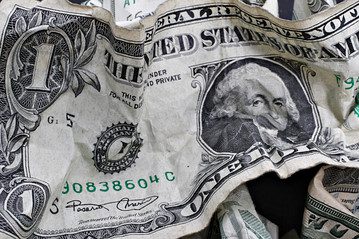 throughout human history we are marching down a narrow path to the final catastrophe of our fiat currency system. [Let me explain why.]
Over the past 40 years, we have printed money and expanded the credit system to grow our economy. During this period, as we papered over cracks that appeared in the system, we continued to grow the economy in nominal terms. By not resolving underlying issues, economic cracks grew into gaping holes requiring increasing amounts of credit and monetary expansion to maintain a semblance of prosperity. Crisis after crisis, opportunities to resolve massive imbalances were simply pushed into the future, allowing those imbalances to compound. While many view the 2008 crash as the apex of the credit and monetary cycle, I fear it is not. Since 2008, economic policy based on credit and monetary expansion has not changed and continues to push an escalating crisis into the future.
Human behavior is too hardwired for us to change paths, regardless of how different we think we are. Even the smartest of men can become seduced by the near-term, quick solutions by which they are judged. Human nature is geared to solve immediate problems (e.g. how to escape the lion creeping through the village) at the expense of lasting solutions (e.g. divert resources and invest the time and energy to build a protective wall around the village). Because of this human tendency, history is littered with the remains of dead currencies that were destroyed by near-sighted policies.
In the wake of this destruction lies the average person, whose savings are wiped out entirely by currency collapse. Think about that for a second: in a bear market an equity portfolio may fall by 10-50%, but the portfolio can still recover over time. In a complete currency collapse entire savings accumulated over a lifetime are wiped out. There is no recovery from a complete currency collapse.
Examples of Complete Currency Collapse
Why should investors and average people protect themselves from what today seems like a low probability/high impact (i.e. black swan) event? Because total fiat currency collapse occurs with remarkable frequency.
Below, I have listed a handful of the worst debacles from the past century alone:
Hungary, 1945-1946
After the end of WWII, amid the chaos of a continent in ruins, Hungary experienced the worst hyperinflation ever recorded. At its fastest pace, the Hungarian pengo was losing half its value every 15 hours.
Zimbabwe, 1998-2009
Everyone’s favorite president (and hobby economist), Robert Mugabe, raided the central bank to cover tax revenues lost to economic “reforms.” At its peak, the Zimbabwe dollar was losing half its value every day.
Yugoslavia, 1989-1994
By filling budget gaps with printed money, Yugoslavia experienced a currency collapse that, at its fastest pace, saw the dinar lose half its value every one and a half days.
Germany, 1921-1923
Probably the most analyzed currency collapse in history, the Weimar Republic hyperinflation was arguably the result of budget deficits created during and after WWI. Notably, the massive reparations payments imposed by the Allies tipped an already weak German mark into a complete collapse. Although the utter destruction of the German middle class was the direct consequence, the German hyperinflation likely hastened the rise of Hitler and the march towards WWII.
Greece, 1942-1944, 1953
Greece is dominating the economic news today, but the country is no stranger to financial disaster, as it has defaulted repeatedly throughout its history. At the worst point of Greece’s 1942-1944 inflation, the monthly inflation rate ran at a whopping 13,800%.
The above five examples are some of the worst inflation cases from just the past 100 years. Looking back even further, we see currency collapses repeatedly across empires and administrations throughout history: Rome, China, France, and even the United States.
The Common Cause of Currency Collapse
In the end, currency crises are usually caused by bad short-term “solutions” to a structural revenue or expenditures problem (i.e. budget deficits). The rest (e.g. are the expenses to cover entitlements, pay for an expanding empire, buy prostitutes and palaces for autocrats?) is just details.
When the deficit problem isn’t obvious, governments using an expanding credit and fiat currency system mistakenly believe that they have mastered their economic destiny. When a deficit problem is obvious, governments often solve it by printing money rather than making necessary painful adjustments. Unfortunately, by the time a deficit problem is obvious it is too late to fix it, since the cure (austerity) would kill the patient (the economy, thereby worsening the deficit).
The bottom line is that governments have historically done everything possible to achieve instant gratification at the expense of long-term solutions. By pushing the difficult decisions into the future, governments simply compound the original problem until it hits an unsolvable crisis point that can no longer be papered over by money printing. Unfortunately, those who suffer most throughout this process – regardless of how long it takes to unfold – are the middle class savers who hold domestic currency and those on a fixed income.
The U.S. Currency Crisis at Cross-roads
Today, the U.S. is at a cross-roads. While nobody denies that US debt and deficits are large and growing, there is a chasm of disagreement on the severity and velocity of the problem…American policy makers are trapped by a national tug-of-war over what to do. The timing of such a battle couldn’t be worse.
The reality of our current situation is dire:
A 30-50 year virtuous cycle of credit expansion which has produced outsize paranormal returns for financial assets—-bonds, stocks, real estate and commodities alike—-is now deleveraging because of excessive risk and the price of money at the zero-bound. We are witnessing the death of abundance and the birth of austerity, for what may be a long, long time. –Bill Gross, February 2012
[And]There is no means of avoiding the final collapse of a boom brought about by credit expansion. The alternative is only whether the crisis should come sooner as a result of the voluntary abandonment of further credit expansion, or later as a final and total catastrophe of the currency system involved. — Ludwig von Mises
It is this great deleveraging that will exacerbate the U.S. budget deficit, causing great economic pain for years to come. The salve that will continue to be applied by our economic overlords: money printing. To quote 80s music group Talking Heads, it’s “the same as it ever was.”…
Conclusion
Perhaps the risk of currency collapse in the near term is still small, but as a hard-working middle class citizen, I’m not willing to risk my family’s security… Whether it happens sooner or later, we are approaching the final catastrophe of the currency system. For that reason, I store some of my family’s savings in gold.
The comments above & below are edited ([ ]) and abridged (…) excerpts from the original article by Mark Motive (PlanBEconomics.com)
Thanks for reading! If you want more articles like the one above visit our Facebook page (here) and “Like” any article so you can get future articles automatically delivered to your feed. You can also “Follow the munKNEE” on Twitter or register to receive our FREE tri-weekly newsletter (see sample here , sign up in top right hand corner).
Remember: munKNEE should be in everybody’s inbox and MONEY in everybody’s wallet!